From the LOFAR ERIC Director
As we move further into 2026, I am pleased to share that the LOFAR 2.0 upgrade continues to make excellent progress. In the Netherlands, most stations have now been successfully upgraded, marking a major milestone for the project. Preparations are also well underway for the upgrade of the international stations, scheduled to begin in the second quarter of this year. I would like to thank everyone involved for their continued dedication and hard work, which are essential to realising the powerful new capabilities of LOFAR 2.0.
I would also like to take a moment to highlight an important development from the November Council meeting: Peter Gallagher was elected as the new Chair of the LOFAR ERIC Council. Please join me in warmly welcoming him to this role. A big thank‑you as well to Jacqueline Mout, our outgoing — and first — Chair, for her leadership and all the work she has done during LOFAR ERIC’s formative years.
Significant strides are being made on the replacement of the correlator (Cobalt) and the central processing cluster (CEP) in Groningen. The technology market remains volatile, with rising prices and extended delivery times driven largely by global demand for AI‑related hardware. Despite this, our teams have been impressively proactive in managing costs and securing the capacity we will need for the LOFAR 2.0 era. In parallel, considerable effort is going into the development, testing, and commissioning of the software systems that will underpin future operations, including the new TULP proposal tool.
The data and compute challenges of LOFAR 2.0 are substantial, with higher data volumes and expanded opportunities for long‑baseline, high‑resolution imaging. Together with the LOFAR ERIC members, I am working to ensure that sufficient resources are in place so that the Large Programmes can begin as soon as possible and that smaller projects can be supported in upcoming Open Time calls.
By the time you read this, registration for the 2026 LOFAR Annual Meeting in Dublin (8–12 June) will be open. I look forward to seeing many of you there, especially at the Observatory Session, where the latest LOFAR 2.0 updates will be shared.
We are all eagerly awaiting the restart of full LOFAR operations in early 2027. The progress achieved so far gives us every reason to be optimistic — thank you all for your continued dedication and hard work.
Michiel van Haarlem
Director, LOFAR ERIC
Announcements
Newsletter format
The LOFAR newsletter has a new look; we have merged the LOFAR newsletter with the LOFAR Development newsletter. This new structure will combine important updates from both operational and development perspectives. The new LOFAR newsletters will be published every three months. To receive the newsletters, users should subscribe to the lofar-news mailing list.
LTA new user account
Despite the switch to new FAAI based accounts (see documentation on LOFAR User Access here) used for staging and downloading, users still need to have a traditional LTA account to create the first request on the LTA web portal. Users who need to create new LTA accounts should send a request via the SDC-Helpdesk. This must include the following information:
-
- your preferred username
- email address (preferably institutional one)
- name (first name + surname)
Data & Archive News
LOFAR2 Data working Group activities & DMP’s (Data Management Plans)
The Data Working Group is making good progress with the preparation of Data Definition Documents for LOFAR2.0 supported data products. The first updates to LOFAR1 specifications are expected to appear in the coming months, in time to be used for preparing the next development planning cycle in Q2.
All LOFAR2 large program teams have submitted a Data Management Plan (DMP) for their proposed science plans. The proposals are currently being assessed for completeness, impact on LOFAR2.0 delivery, and readiness of the programs. This was the first time that the Tulp proposal application and the federated authentication and authorization mechanism have been used by the wider LOFAR community for submitting material. We are pleased with the successful application of the new services and will use the lessons learnt to improve the user experience, in particular with respect to those users that do not have access to an institute account which provides access to the international research federation infrastructure.
LOFAR Data Valorisation
The LOFAR Data Valorisation (LDV) activity gives added value to the Long-Term Archive (LTA) by offering users well-curated data and advanced data products. It also paves the way for LOFAR2.0 operations because it streamlines data processing operations at the LTA sites (currently SURF, Juelich and Poznan) and ensures sustainability of science operations by reducing the storage demands at the LTA, thereby also lowering the operational costs. LDV has made enormous progress over the past few months. Specifically, Early cycle LOFAR1 data that was concluded to not provide legacy value has been removed from the LTA. At the same time, the footprint of early cycle LOFAR1 is being reduced through retroactive application of the current standard compression techniques in collaboration with science teams that have requested continued availability of early cycle data. As a result of all this, the LOFAR1 data archive footprint has halved and has been reduced by more than fifteen petabytes in 2025. This was a very important milestone. Further savings will continue in 2026 and 2027 thanks to the expansion of the processing infrastructure to Juelich and Poznan. In 2026, this will happen in parallel with the processing of LINC and RAPTHOR on a portion of the data at SURF to generate advanced data products. Through this, we will also demonstrate the performance of these pipelines in the production system.
StageIT
StageIT has now fully replaced the old stager service that is no longer available. With the introduction of StageIT, LOFAR provides data access primarily through highly scalable WebDAV servers that are provided by the LTA data centers and the use of access tokens. The old download servers have been decommissioned. Users should be aware that LTA sites, starting with SURF, soon will also no longer support the old SRM protocol for accessing data. As a result, scripts and Python tools for working with the LOFAR LTA need to be updated accordingly. More information on the new data access mechanisms can be found in the documentation provided on the LTA portal, in the StageIT service, and on the ASTRON science web pages. An extra update on StageIT can be found under the SDC Development Program section below.
Events
LOFAR Data School 2026
We are in full swing with the preparations for the next LOFAR Data School, sponsored by the ACME project, which is planned to take place from September 16th to 23rd. The registration is now open and will remain open until April 20th.
We are also updating the online learning environment in addition to the school’s program to provide more added value to the participants. Additionally, for the first time, this edition of the school will extend over the weekend, which the LOC believes will add to the overall experience.
If you have any question(s) or need further clarification, you may contact us via lofarschool@astron.nl.
LOFAR Forum
The LOFAR forum has meetings regularly now every month. Discussions include updates on LOFAR commissioning and regular science updates. The content and presentations can be found on the slides repository. The audience is expected to be the broad LOFAR community, which includes researchers across all science areas and telescope modes, and the dedicated scientists and engineers who are working hard to enable this science.
If you would like to give a community-based talk on a particular topic, or if you would like to nominate someone to give a talk on a particular topic, please fill out the following form: https://forms.gle/LGt2Nf2DqYW8mAMv7. Note that you can use this form more than once if you wish to submit multiple (self-)nominations.
LOFAR Development News
Status of LOFAR2.0 rollout
Number of LOFAR2.0 stations verified: 32/38
The remaining stations in the Netherlands will be verified in the coming months, as soon as the network connections are established. In the meantime, the AIV team is preparing the rollout of international stations to start in spring/early summer. The planning of the rollout is prepared in collaboration with the station owners in each country.
From paper to reality: CEP hardware is here! (Ilse van Bemmel on behalf of the CEP Project team)
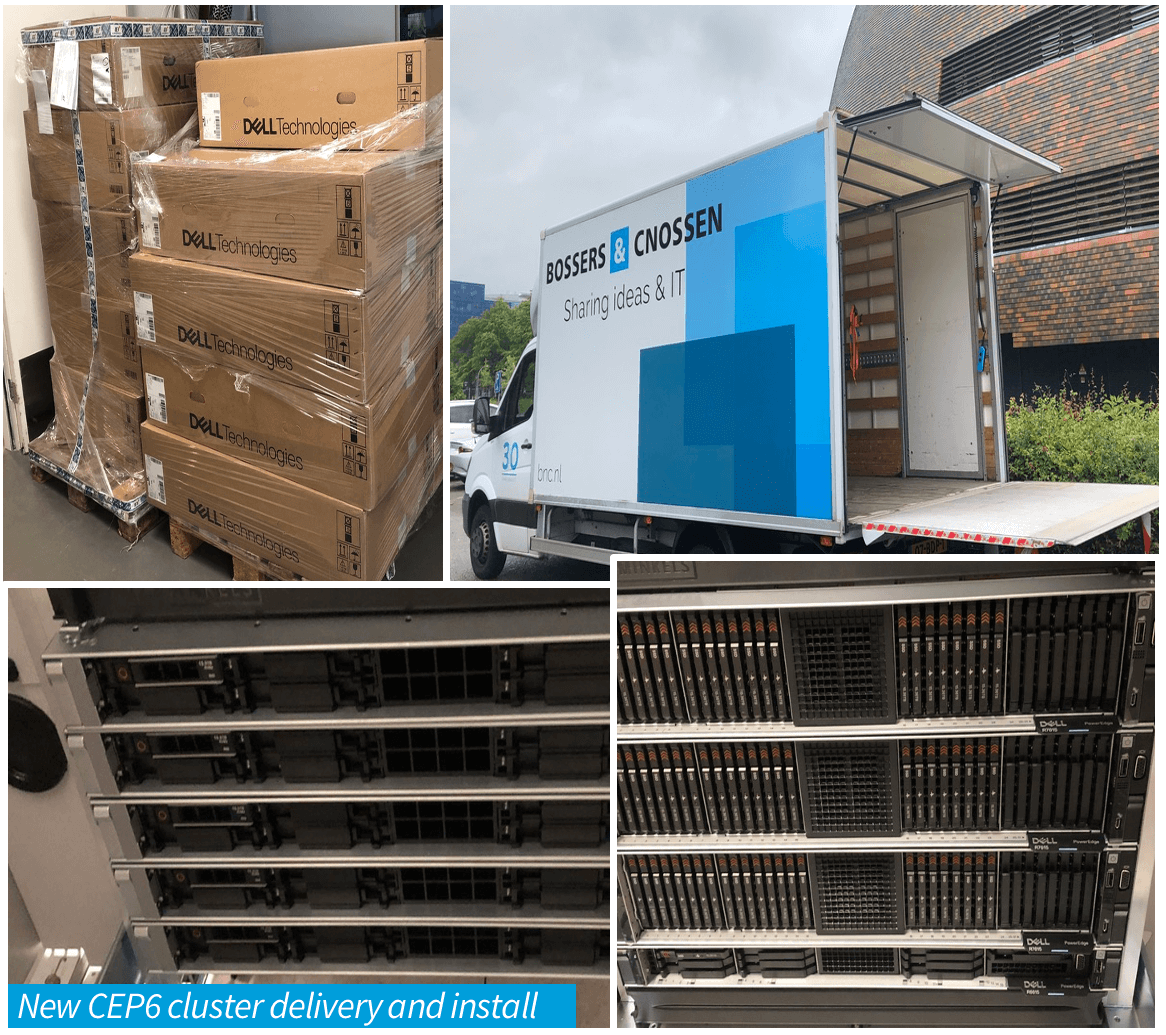
Major steps have been taken in the CEntral Processor (CEP) replacement project since the last update just before summer 2025. We went from having plans on paper to a real and operational CEP6, and Cobalt3 hardware is rolled out.
CEP6 compute and storage
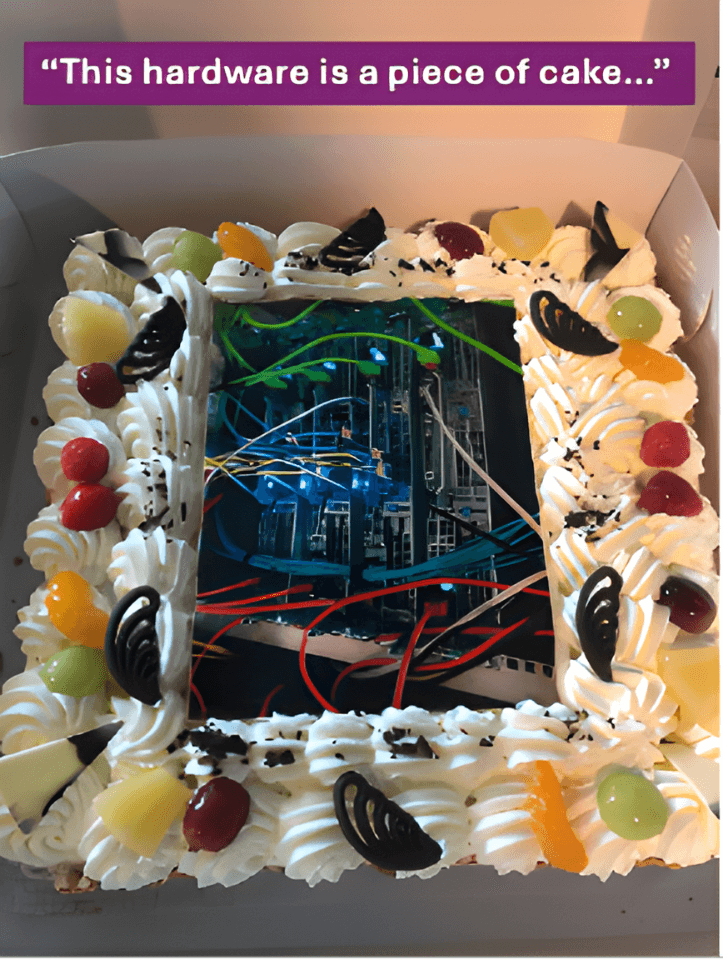
In September 2025 the preprocessing cluster transitioned from CEP4 to CEP6, with successful completion and celebratory cake on 7 October 2025. The process was planned for a full month to ensure that impact on commissioning was limited. The “busy days” every Tuesday were such a success that they were continued for integration and verification of the Minimal Production System. The current CEP6 was specified to provide ~50% of the processing power needed for full LOFAR2.0. As this was heavily based on our experience with CEP4 the specifications included a significant error margin. To compensate for this, a minimal purchase was made first, with a second purchase planned late 2025, and a third one in summer 2026.
A benchmarking test in October showed that the CEP6 hardware is exceeding expectations, and we decided to wait with ordering the second phase of hardware as the system provides more than sufficient compute and storage for the coming 6-12 months. This also allows us to do a more in-depth benchmarking early 2026 with more LOFAR2.0 stations and the latest software products.
Towards the end of 2025 there were signals of an upcoming price increase for memory and SSDs, leading to fast-tracking the order of the residual CEP6 storage nodes, with delivery late January 2026. With these additional nodes the CEP6 storage is at the required capacity for LOFAR2.0 operations. The compute nodes are still at 50% and more than sufficient to enable us to finetune the specifications for the next purchase and wait for the market to calm down.
Cobalt3 correlator
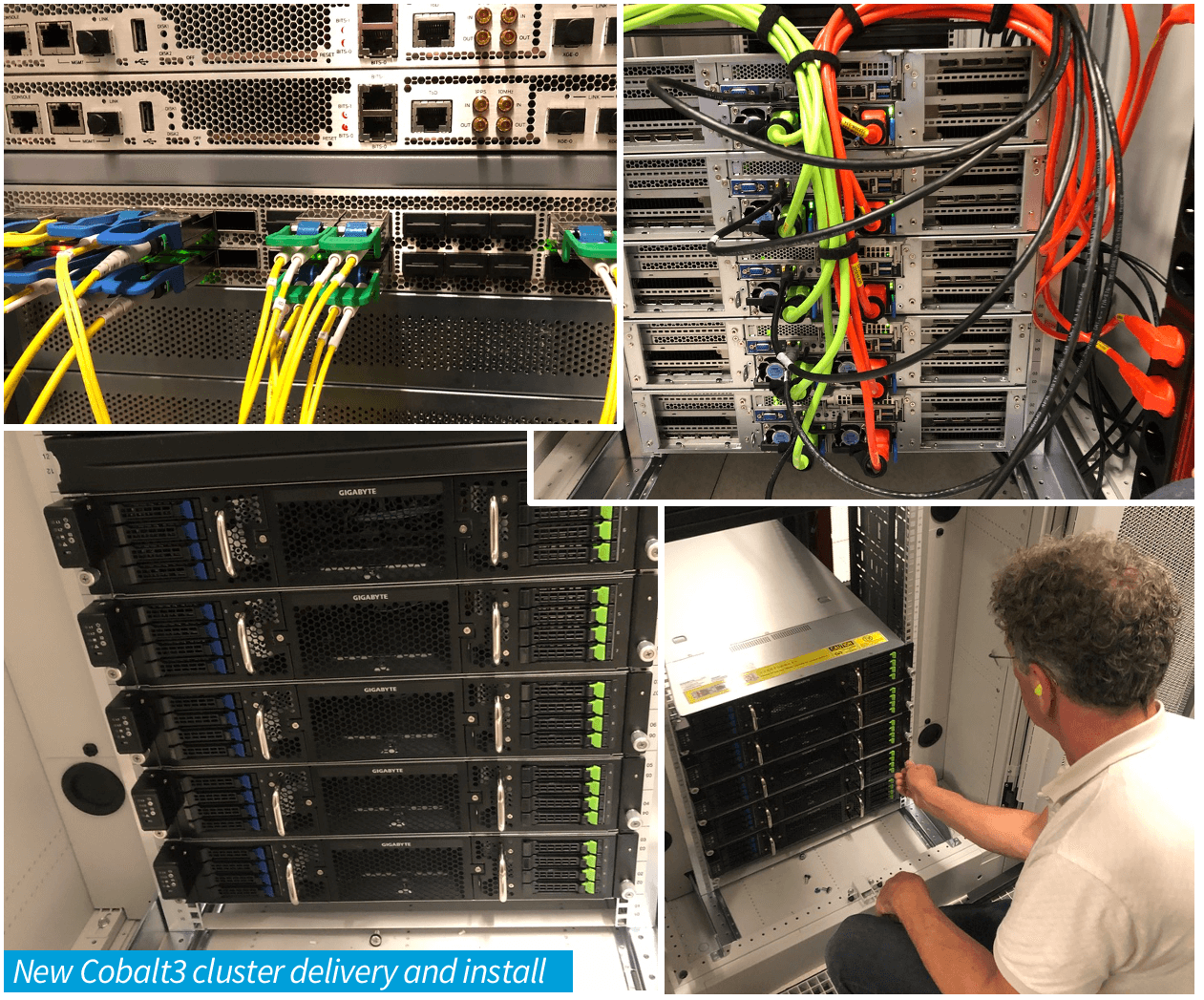
The delivery of Cobalt3 hardware took significantly longer than expected, resulting in a major change of plans. Instead of using Cobalt3 for the Minimal Production System (MPS), we decided to continue using Cobalt2. Some additional nodes were revived to provide sufficient input bandwidth, and this created space in the planning to focus on MPS and roll-out Cobalt3 hardware later. The roll-out has happened and is now in operation since the start of February.
This is the first step in the full Cobalt3 system roll-out and will result in the Cobalt3 hardware running with the existing Cobalt2.2 software to ensure that everything is working. A short (few weeks) overlap is planned in which Cobalt2 continues to operate as well, which is possible thanks to the Multicast network. At the end of February, the Cobalt2 hardware will be shut down, and we will start the roll-out of Cobalt3 software, which will include the TensorCore beamformer and correlator developed in the Radioblocks project. By the 1st of April the Cobalt3 system should be fully up and running.
Completing the CEP systems
With these major steps, the CEP systems are now a reality. The next step is to perform a dedicated benchmarking of the CEP6 compute systems to estimate how much additional hardware is needed and by when.
Once Cobalt3 is fully operational, a complete CEP systems benchmark is planned in June 2026. This will give us more detailed information on the performance of the system as a whole. The outcomes will provide information on the final steps needed to complete the CEP system.
Telescope software update (Tom Kamphuis on behalf of team Ruby)
Over the past months, we have been very active in getting our first internal version (the Minimal Production System or MPS) of the telescope ready for the commissioning team. There was (and still is) much focus on testing the system, analyzing the findings, and further improving it. This constant feedback loop is still running, and we hope to end it by the end of February to have a stable system for our commissioners to work with.
Although the system was not fully stable for commissioning, we celebrated our development achievements for the MPS with a nice internal celebration party at the end of 2025. During this celebration, we showed our progress in multiple areas (from TULP to the LTA, TMSS, the integrated pipelines, and more) at various locations within our building and had a treasure hunt to top it off.
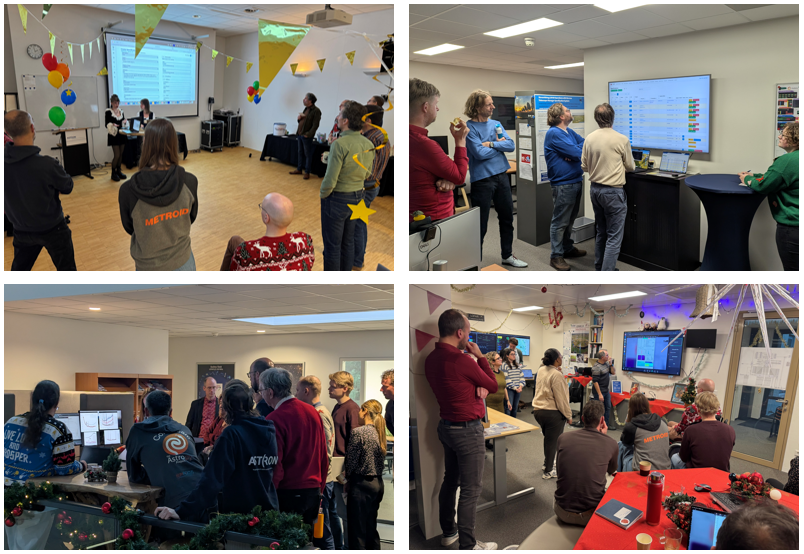
Measuring LOFAR2.0’s sensitivity (Michiel Brentjens on behalf of the commissioning team)
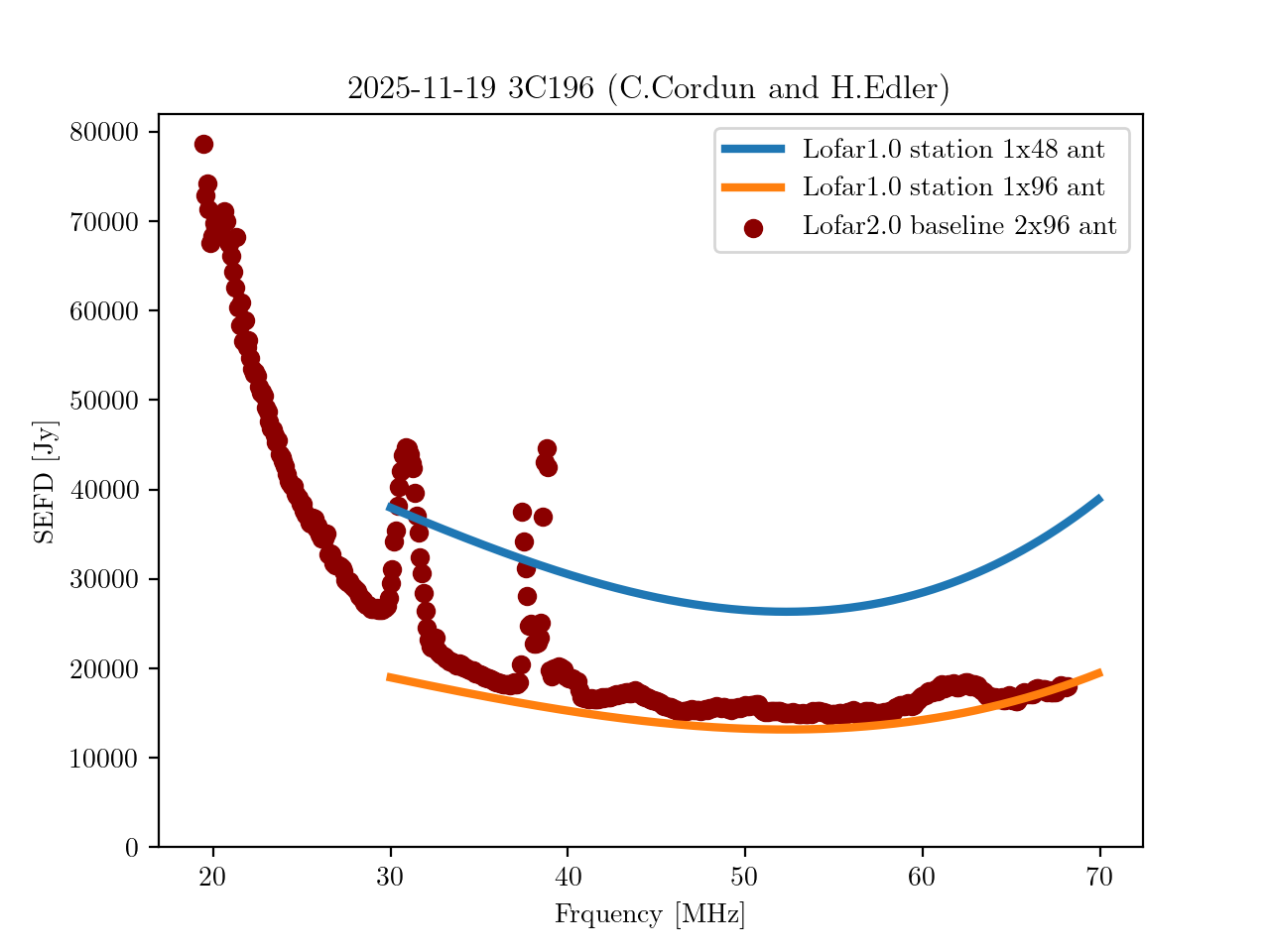
One of LOFAR2.0’s objectives is to increase the LBA sensitivity by up to a factor 2 by using all LBA antennas simultaneously instead of only half of them, as was the case in LOFAR1.0.
The figure below shows the mean measured SEFD per LOFAR2.0 station under circumstances similar to those under which the LOFAR1.0 SEFD was measured. As hoped for, the noise is almost a factor two lower than for a LOFAR1.0 station! We also see that at lower frequencies, the improvement is progressively less. This is caused by the fact that the innermost LBA antennas in a station are much closer than a wavelength, causing interactions between these antennas.
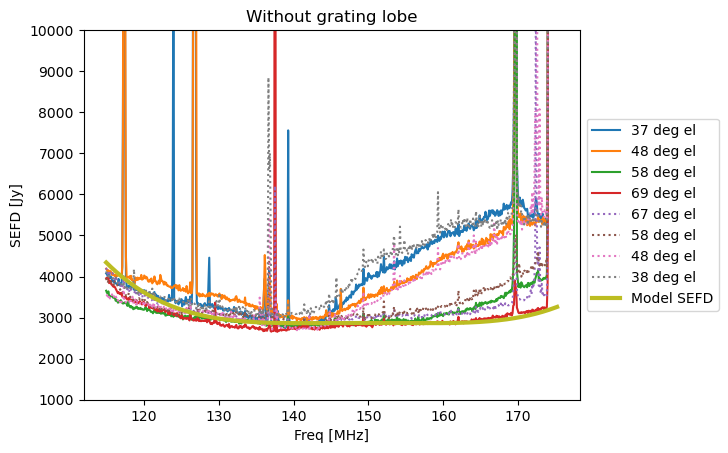
For the HBA, Cristina performed observations at multiple elevations, both rising, and setting. These observations were corrected for the HBA element beam patterns, which worked quite well below ~145 MHz. Above that frequency, we see large deviations from the model SEFD that was based on LOFAR1.0 observations at 3C196’s transit.
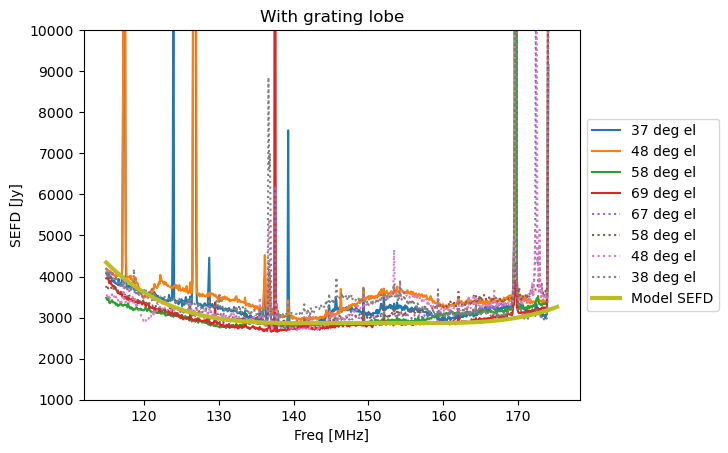
These deviations turn out to be caused by the grating response of the tile- and station beam, due to the regular layout of the HBA station. After correcting for those (final plot), the SEFDs are much more consistent. This correction now allows us to measure SEFDs at many more elevations, which will make this a much more practical tool to assess LOFAR2.0’s sensitivity at a regular basis.
The following quarter we will focus on assessing clock quality, calibrating the core’s tied-array, and — as soon as the Cobalt-3 hardware is integrated — conduct full-core pulsar observations, and hopefully make the first NL-scale resolution HBA images with LOFAR2.0!
SDC Development Program (J. Swinbank on behalf of the SDC Development Program)
The SDC Program continues to focus on making LOFAR2.0 a usable, accessible, and scientifically productive system for the whole community. To that end, we have spent the last several months rolling out some new tools that are now available to everybody, and doing a lot of behind-the-scenes work that will help make the Observatory more flexible and powerful when LOFAR2 enters operations.
The major user-visible change has been the switch to the new StageIT system for retrieving data from the LTA in November. StageIT is a huge upgrade from the old stager — it is easier to use and more robust, it supports the latest technical standards, and it's a much easier codebase for us to maintain and develop in the future. Any major software infrastructure transition like this brings some glitches, but overall, we are happy with how smoothly the StageIT rollout went. If you are having problems or have any other feedback on the system, we would love to hear from you.
StageIT is also one of our first services to support “federate authentication and authorization”. That means that you are able to log in with your regular institutional account (from your home university, research institute, etc) rather than making a special account on LOFAR systems. This has several advantages — not only does it mean you have fewer account details to remember, but it means that we don't store any of your personal information or login details. This is both more secure against malicious actors, and more robust against possible failures. And don't worry: we have no access to any of the information that your home institute stores about you.
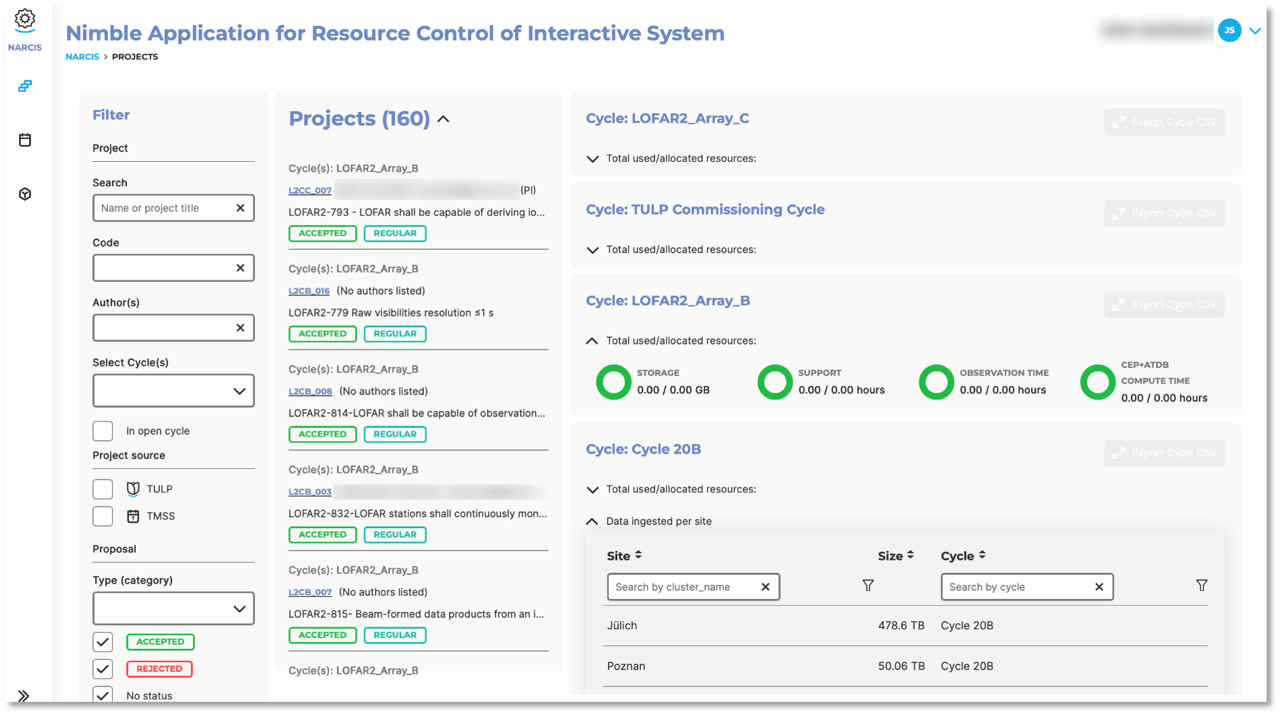
Behind the scenes work over the last several months has concentrated on ensuring we have a robust system for managing pipeline processing over the distributed data system and ingesting the inputs into the LTA. This has been making great progress; we're particularly excited about progress on NARCIS, the “Nimble Application for Resource Control of Interactive System” — despite the rather convoluted name, this is a fantastic new tool that lets our operations team track the progress of data processing and archiving projects, and the associated system resources, across our infrastructure. See the figure a screenshot of NARCIS in action; even at this early stage in development, it is already a really useful tool.
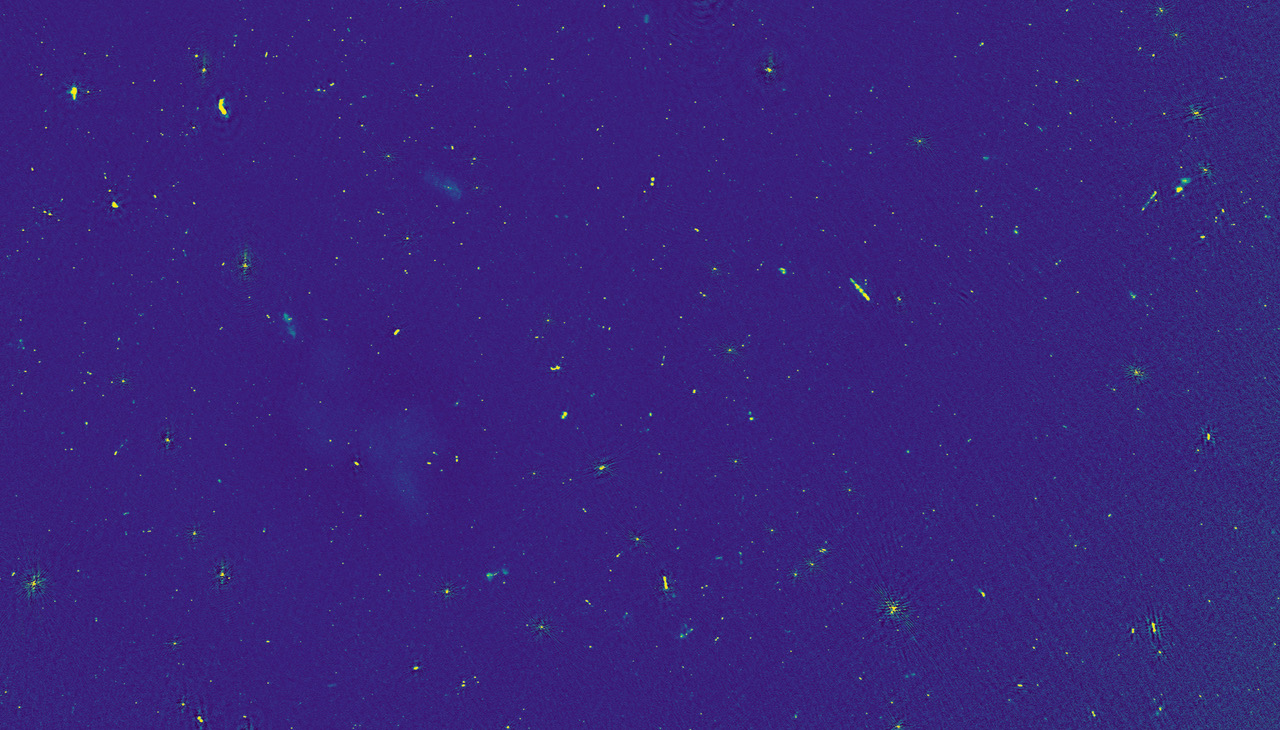
Work has also continued on the development of data processing pipelines. In particular, we highlight the release of Rapthor 2.1 in December 2025. This is a big step forward in terms of both the quality of results and the processing time required to generate them from previous versions. This has taken a huge amount of work from the team, but we're also very grateful to the various collaborators and other experts who have contributed to the development process. See the figure for an example of Rapthor 2.1 results (credit: André Offringa & the Rapthor team), and go to https://rapthor.readthedocs.io/ to download and try out the latest version of Rapthor for yourself.